In a recent comment, one of my readers said, “Some Renaissance art can really bore a person to tears.” This is true, but it can also make a person smile, trigger reflection, and spark inspiration. To prove my point, I’ll take you on an adventure to visit an “average” cathedral in a town, which many believe is worth staying in for no longer than half a day.
Frankly, I am yet to see such a town in Italy. Even a hill-top medieval castle can provide ample entertainment, especially in a wine-making region.
We are in Verona, in front of the Basilica of San Zeno.
At first glance, there’s nothing extraordinary there. It is a typical Romanesque church with a Gothic rosary window, massive gates, a bell tower, and marble bas-reliefs on the facade.

This square is the best place to think of European history and culture—not because the square is pretty, but because of who helped build the Basilica.
It was initially a small church on top of Saint Zenon’s grave, built by Theodoric the Great (5th century AD), king of Ostrogoths, who killed Odoacer, king of Goths, and became the King of Italy. I’d love to strangle Odoacer, too, for he was a Goth chieftain who introduced us to the Dark Middle Ages by deposing the last Roman Emperor. Theodoric whacked Odoacer at a reconciliation dinner with a sword blow that almost cut his opponent in half. Odoacer’s wife was stoned to death, his brother was killed by archers, and all of Odoacer’s troops were killed, too. If you are a GoT fan, you will find a connection to the series’ most gruesome scene here.
Having become the King of Italy, Theodoric married a Byzantine princess, developed an interest in the arts, and started sponsoring philosophers working on Aristotle and Plato translations. Without the Great Theodoric, we might have had a delayed Renaissance.
The small church erected by Theodoric was replaced in the 9th century by a cathedral, sponsored by the King of Italy Pepin, a son of Charlemagne, and brother to Pepin the Hunchback, immortalised in the musical Pippin, wildly inaccurate historically but warmly received by the public. Pepin [the Straight Back] made Verona his capital and the epicentre of the Carolingian Renaissance, which set the standard for lavishly illustrated books and pushed visual arts in new directions. Look at the pink sky against the blue landscape in this manuscript:

Without those books, the “real” Renaissance would have been delayed again.
Finally, in the 10th century, the Cathedral took its more or less current shape with the help of the Holy Roman Emperor Otto I, who launched the Ottonian Renaissance (again, mainly in book illustration, but with the valuable addition of ivory miniatures).
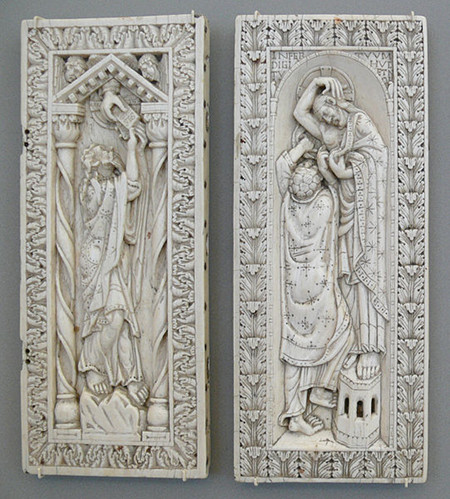
Thus, we are standing in a square that has seen three kings from the Dark Ages (two Germans and one French) who promoted progress and innovation, accelerated the arrival of the Italian Renaissance, and, ultimately, helped create the modern world as we know it today.
Now, the “geopolitical” part is over, and we are in front of the bas-reliefs on the Basicila’s facade.
The good thing about Romanesque bas-reliefs is that they are always full of life. In the 12th century, when the reliefs were made, artists felt most free when working with stone. There were iron-cast canon rules for icons or frescoes at the time, but given the variation in the size of bas-relief panels and the quality of tuff or marble, these rules could be applied to sculpture only loosely. In addition, book illustrations and small ivory panels provided excellent examples of how to build a composition in a relatively limited space to max out the emotional impact.
If I were your real guide, I’d ask you to scan the bas-reliefs, choose three that speak to you, and then give them nicknames.
My choice was this:
I’LL HAVE THE RIBS
ROUNDED
OH, SHIT!..
Now, this is why I chose them.
I’LL HAVE THE RIBS
My experience tells me a rack of lamb is more often ordered by men than women. Is it because men subconsciously feel the lack of a rib? It proves that the first woman was made out of Adam’s rib if true. The theory of evolution cowers in shame.

Artistically, it is a clever composition, combining the STILLNESS of Adam with the CONTROLLED MOVEMENT of Eve (God being at the controls). Note that God is MOVING AND STILL AT THE SAME TIME. Also, note that Eve is almost perpendicular to Adam.
There’s one thing that puzzles me, though. If Adam and Eve have no concept of sin and are made in God’s own image, why is God dressed, and they are naked?
If I were Adam, at some point, I’d ask myself why I am not given a white robe with the hem of which I could play, like God, who’s doing just that while pulling Eve out of Adam? I’d ask God, “Why am I and my girlfriend sun-tanning without bathing suits and everybody else flying around in white robes and shining armour?”
Anyway, it is a clever compositional job of dynamics and stillness.
ROUNDED
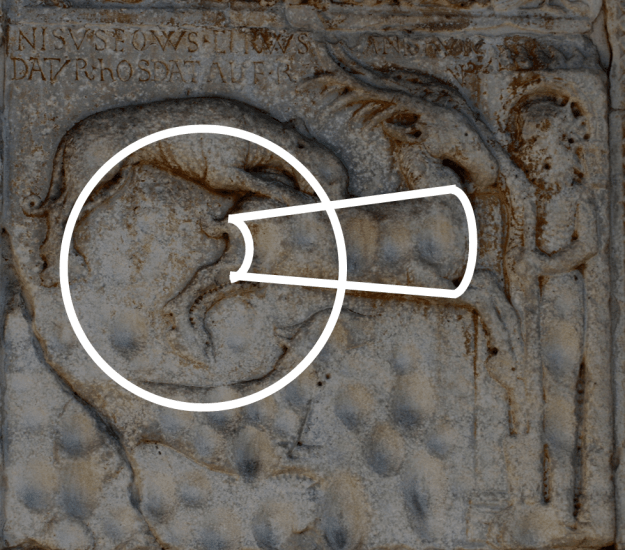
There are two hounds and a deer. The hounds want to stop the deer, which doesn’t want to be stopped.
The dogs circle the proud animal and bite its back, but the deer tries to break that circle using its greater inertia.
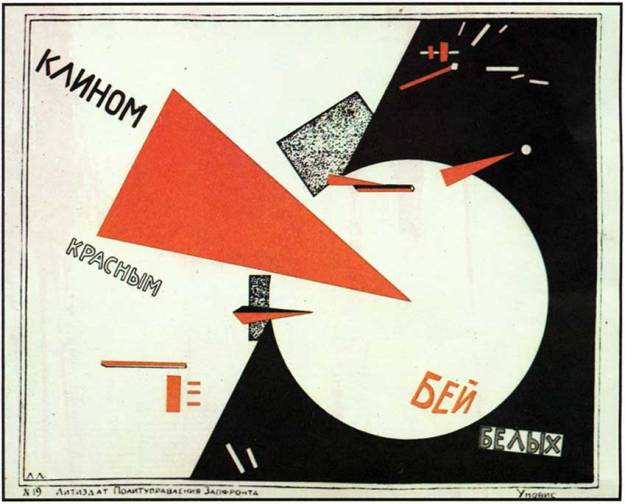
The 12th-century artist expressed animal motivation in a few very simple forms: Two hounds form a circle while the deer breaks it.
The 20th-century avant-garde artist El Lisitsky did something similar in his famous propaganda poster of 1920, “Fight the White Counterrevolution with the Red Wedge”:
OH, SHIT!…
This is Theodoric defeating Odoacer. A simple act of vengeful murder.
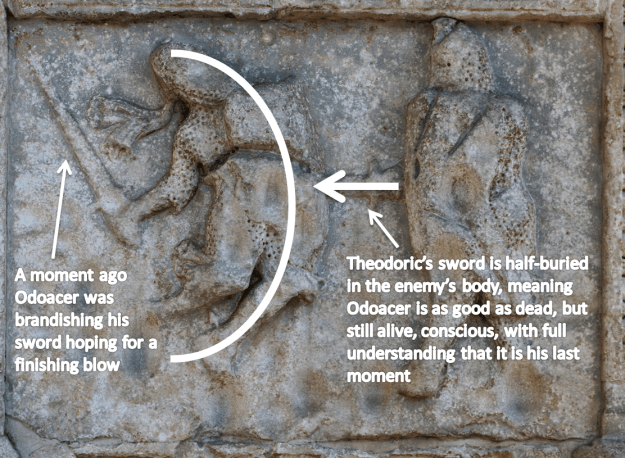
The beauty here is that both fighters are alive, but one has already lost the battle. We are shown the moment when the defeated has just realised it is the end. He fought well, but it never mattered for his almost serene opponent. It was his destiny to win.
Theodoric is said to have killed Odoacer with a single blow. The arch of Odoacer’s body against Theodoric’s wall-like posture communicates this part of the story.
The 12th century was not an age when people needed to learn how to cut stone.
Now we can go inside, click here for Part II.
 Standing Ovation, Seated
greener pastures
~
envying what
we’ve never seen
bark
texture
branches
scent
vancouver was forest
during
the renaissance
~
discerning
cedar
from
hemlock
Moscow was a motley colleytion of huts inside a tiny fortress made of spiked logs at the time )
Not at all boring…And love how you bring in El Lissitzky!
Thank you! That’s exactly my point – ancient art can talk to the observer who is willing to listen )
My favorite Renaissance artist will always be Giotto. I just love how clearly transitional his work is from International Gothic to pure Renaissance.
I can’t say I have a favourite artist in any of the epochs. I like lamb, but also veal, and pork, and… Just like different dishes and recipies, different artists make my life richer and tastier. But I will get to Giotto at some point. After Verona, I’ll move on to Bologna, then to Siena (and I will talk about some of Giotto’s contemporaries), then to Perugia and Assisi – and there, finally, I’ll have Giotto ) Lots of him )
He’s not so much my favorite for his work per se, but more for his shear impact. I’m glad you’re beginning with the Romanesque Era, which I think is the most underrated era in European art.
Delightful, wicked and educating post as always! Was it really just 3 pages?
Thank you ) More pages to come!
There are people who are bored by Renaissance art? Wonderful post, as usual.
A lot of people are, unfortunately. Thank you – I am glad you enjoyed it. It is going to get more interesting further on )
Knowing how to analyze art always makes it WAY more interesting. Hooray art history! Thanks for sharing!
I am glad you liked it, and especially grateful for going through all the three pages ) Thank you!