A smiling saint?
A graffiti on a 13th century fresco, left by one of your ancestors?
A fashion idea from the 14th century?
This is what awaits us inside the Basilica of San Zeno. We spent some quality time outside it, and now is the time to enter.
If you have a toddler with you, you MUST come in, for San Zeno is, among other things, a patron saint for kids who are learning to walk, speak, and use the pot rather than a pamper.
Prepare to be amazed as the Basilica reveals its grandeur. It seems to expand magically on the inside, much like a VW Golf in their advertising, where a lady driver (how sexist) can’t squeeze her relatively small car into a seemingly huge space between two parked cars.

Most people rush to see the masterpiece altar painting by Mantegna, but we’d first go and see Saint Zenon. It is his church, so we must pay respect to the patron saint.
This is his 13th-century statue, created by an unknown artist, who, as we will see in a moment, must have been the Picasso of his time. To appreciate it in full, we must first learn something about the saint.

Saint Zenon lived in the 4th century. He came to Verona from northern Africa and was brown-skinned. This was confirmed a few years ago when scientists ran tests on his remains, kept in the crypt of this basilica, and went as far as reconstructing his face. He left a volume of well-written sermons, in which he made a strong point against the Aryan Heresy (Aryans didn’t believe in the Holy Trinity: they could not rational out the concept of the Son of God being the same as God the Father). The Trinity concept is complex, but Zenon offered a metaphor that more or less summed it up: “The Son and the Father are like two seas connected by a strait of the Holy Spirit”.
Saint Zenon was not just a figure of intellectual prowess, but also a beloved member of the community. The common folk fondly remembered his habit of fishing in the local river, a pastime that has led to him being portrayed with his bishopric staff that doubles up as a fishing rod. His kindness towards children and his success at mass baptism endeared him to many, earning him the reputation of being an all-round nice chap.

His sculpture has a kindly smiling face (standing out against the backdrop of stern faces of other saints):

… and a HUGE blessing hand with hyperbolised fingers. Note how the right hand is visibly larger than the left.
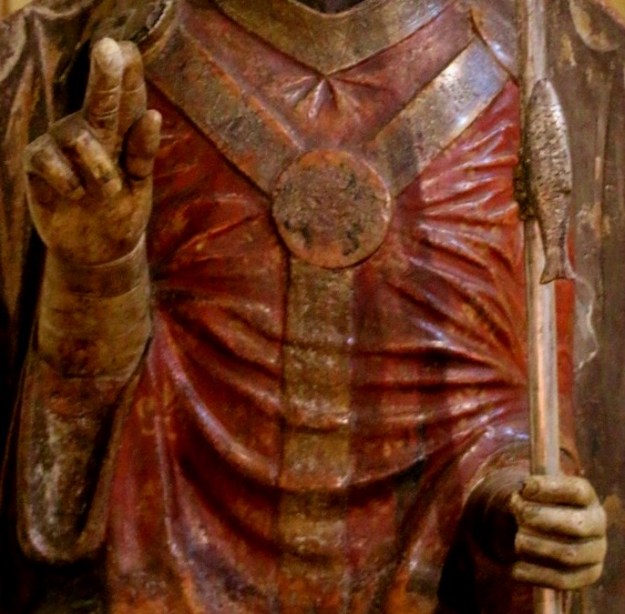
This is exactly what slightly maniacal Picasso did to fingers, noses, and some less appropriate parts of people he portrayed when he tried to convey their character or motivation.
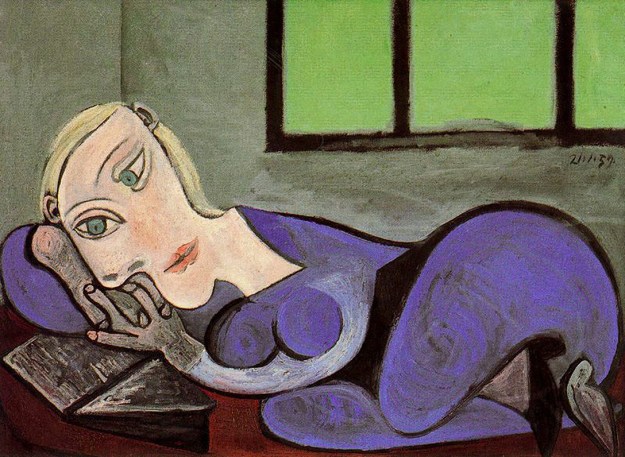
There are a few weird elements in this sculpture as well.
The chair of the saint is meant to remind us of angelic wings, but there are two disturbing elements in its design: monkey heads on the sides. They don’t look like friendly pets:
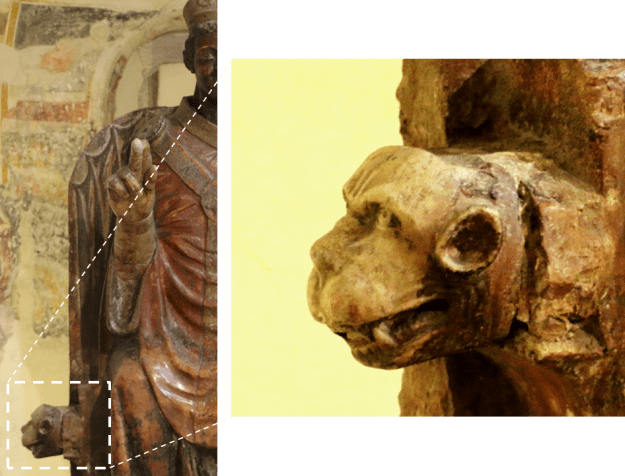
I don’t know if they were meant to remind parishioners of Zenon’s African origins (it would be seen as very racist today) or to scare off a stray demon. Still, they provide a stark contrast with Zenon’s amiable expression.
This sculpture was made about 900 years before the creators of Dogma came up with the Buddy Christ idea.

It is made of red marble, a beautiful stone itself, and I wonder if the sculptor wanted to leave it as is rather than paint it over. He certainly left his other two works in this cathedral unpainted.
Those are the lion of St. Mark and the ox of St. Luke, supporting the twisted columns of an altar that frames a series of frescoes from the 13th to 14th centuries.


The two evangelists turn their heads to each other and open their texts as if to compare the accuracy of their memories. When you are standing between them, there’s that strange feeling you’re attending a book signing session with two authors competing for your attention. Strangely, these two anthropomorphic animals of the 13th century look very much…alive and kicking.
I am especially fascinated by the ox, which—as an animal—is not known to possess high intelligence. Yet, this one has the benevolent expression of a philosopher who might want to speak out but has chosen to breathe through the nose, given the potential listener’s perceived lack of understanding.
Now, if I were your guide in this cathedral, I’d ask you to think of how Christianity might be different if all saints were smiling? My guess is that the Inquisition would be tickling their victims to death instead of burning them at the stake, and the Pope may approve of dope.
Now, the last thing to see before we turn to Mantegna, is the wall with ancient graffiti.
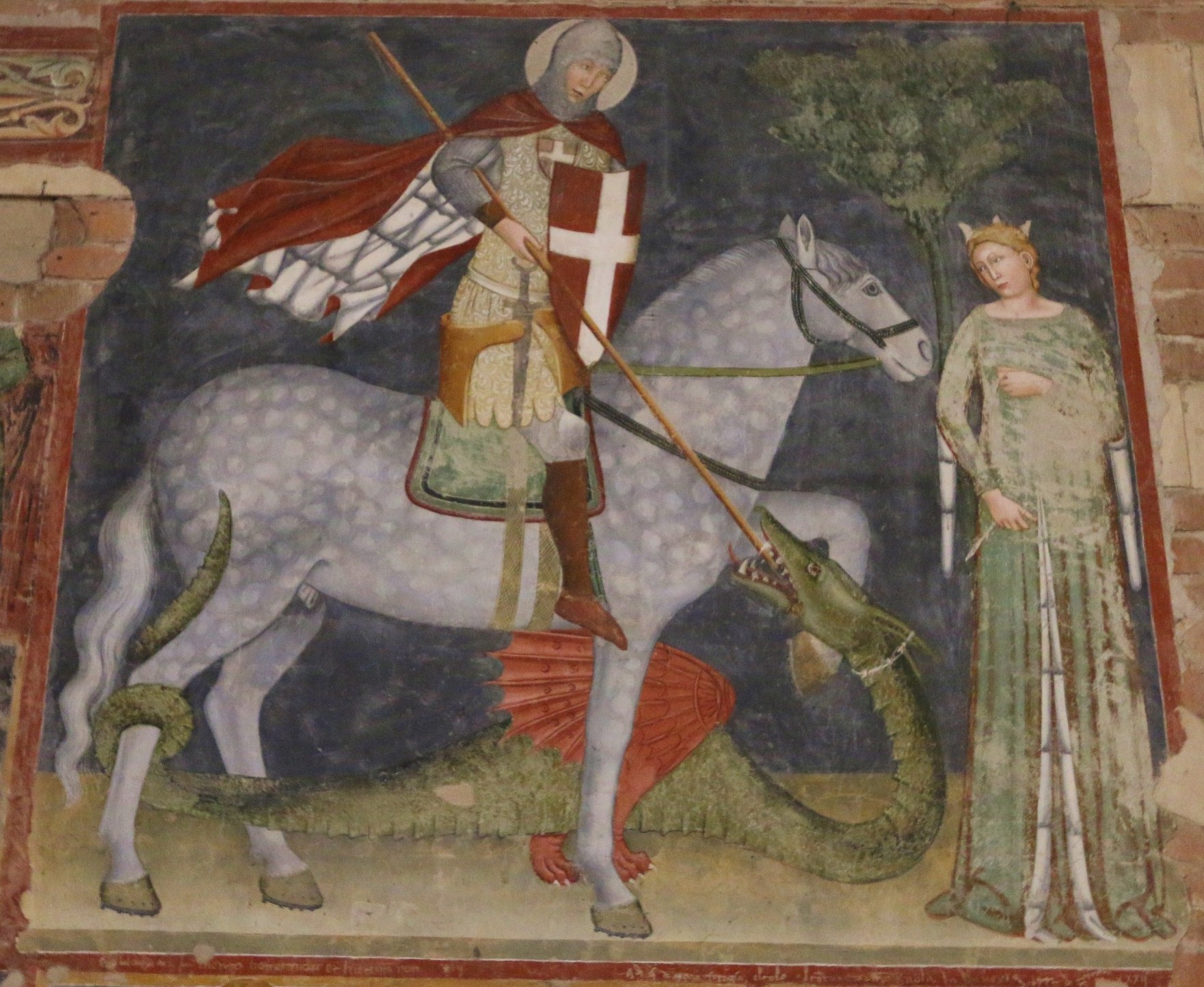
One of the walls in the Basilica is covered by a motley crew collection of frescoes dated from the 12th to the 14th centuries and done by different artists, so today, it looks like a Pinterest page of unrelated subjects. My favourite is the story of St.George (I wrote about it here, and if you haven’t read this post about knights, brides, and pet dragons, you may like it).
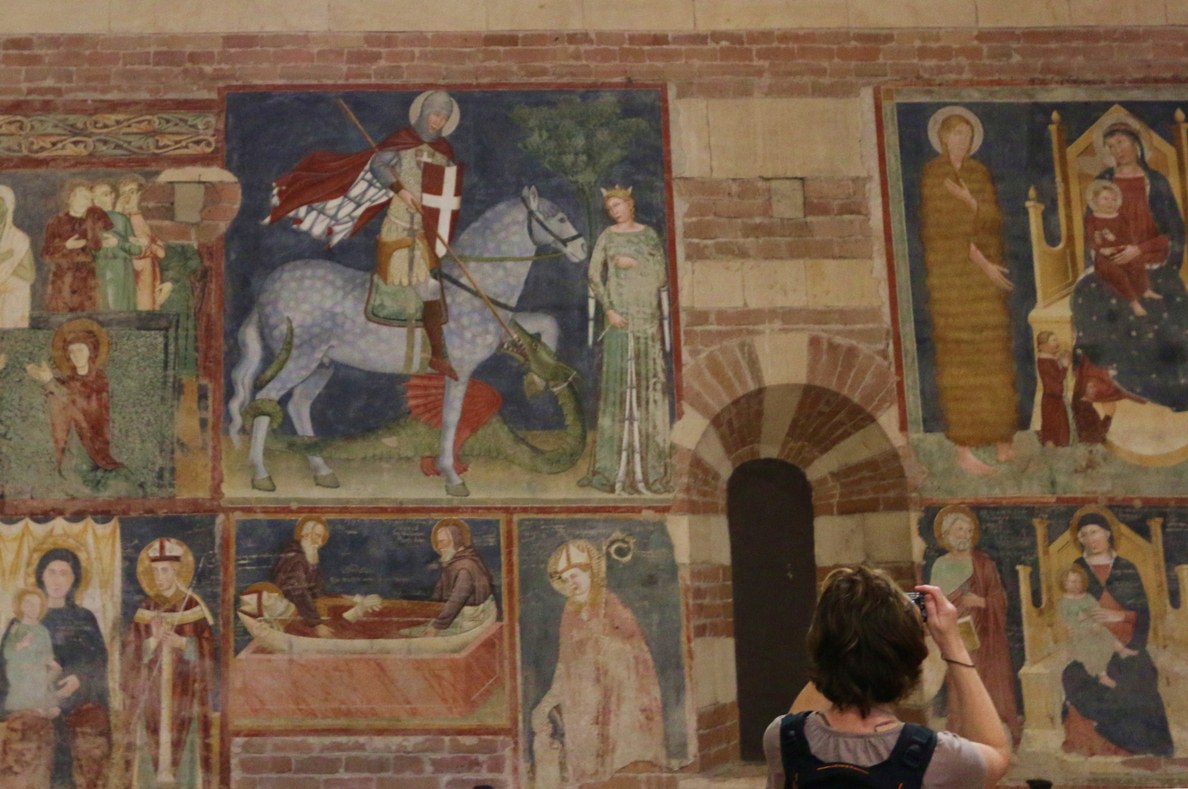
Again, St.George kills a pet taken on a walk rather than a demon that imprisoned a princess. A fashionista may appreciate the lining of George’s cloak and how its geometrical forms contrast with his dappled horse. A perverted mind may enjoy the eroticism of the dragon’s tail winding over and up the stallion’s leg. Anyone can find something resonating in this frescoed encounter.
Frescoes at the bottom are all covered by graffiti, which the devout and not-so-faithful had been leaving on the wall for seven hundred years. You can’t leave your mark now, but you can study what others thought was important hundreds of years ago.
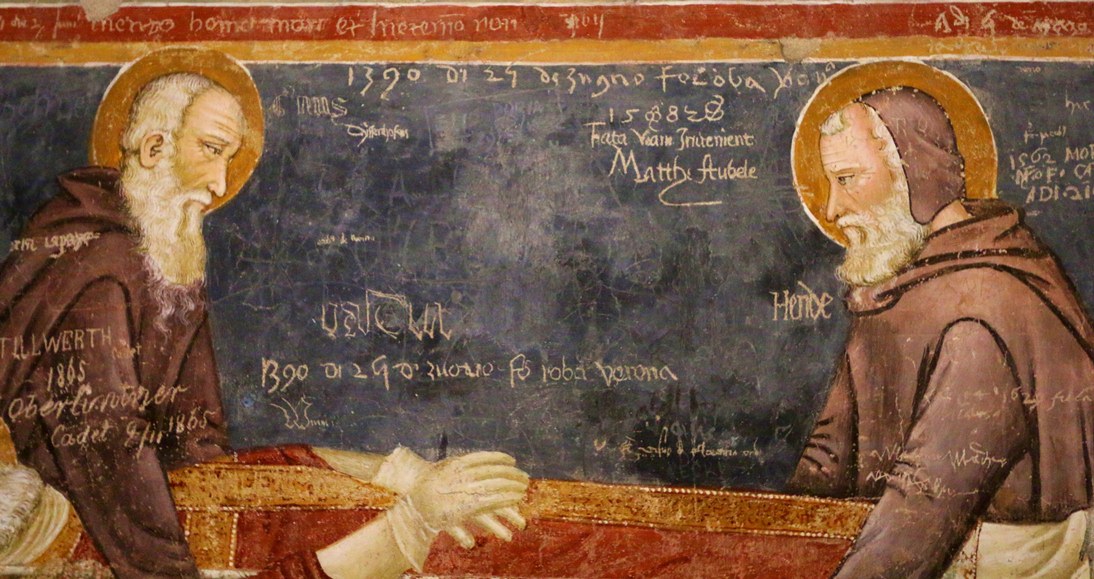

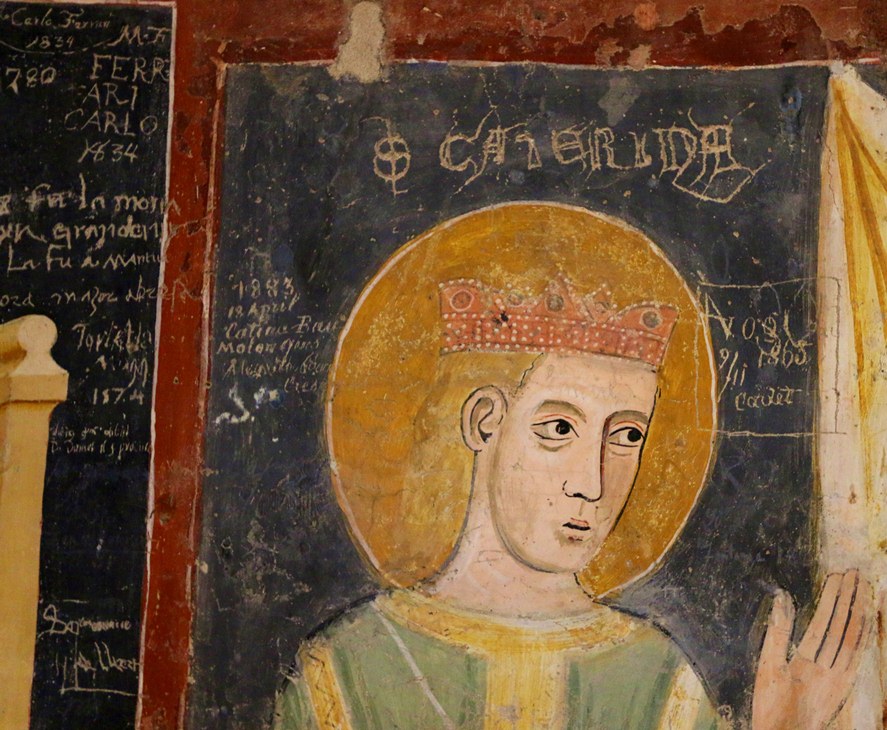
Again, if I were your guide, I’d ask you to find inscriptions about the flood of the local river in 1239 (it pulled down three stone bridges!), the seizure of Verona by Gian Galeazzo Visconti in 1390 (the guy poisoned his own uncle to become the first Duke of Milan five years later, and as it often happened to medieval villans, he then developed a taste for sciences, books, and arts), or the decapitation of Carmagnola in 1432. Carmagnola was a great military mind who tried to bluff while playing political poker with Milan and Venice. Venetians cut his head off, even though he was friends with the Doge: as businessmen, they could not forgive a betrayal if the loyalty had been paid for.
If you have teenage kids, the wall can be your playground to bring history to life.
We will be heading over to the main attraction of the Basilica now, the Altarpiece by Mantegna. Go to Part III to read why Donatello was a genius, how Jacopo Bellini influenced Mantegna, and what it was like to be a 13-year-old boy in the company of three great artists.
 Standing Ovation, Seated
Our ancestors painted so many graffitis without caring whether we had to study them some centuries later… how inconsiderate!
I think they did care, actually. Look at how nicely all the letters are spelt out. Non your modern incomprehensible abrakadabra ))
I haven’t heard of St. Zenon. Its very interesting that the statue actually matches his physical appearance, unlike St. Maurice who was originally white but started being shown as black one day.
The lion sculpture reminds me of Chinese lion sculptures. Do you think that’s a coincidence? I’d think it would be, but you never know.
It is a coincedence. It is believed the supporting lions (very common in Romanesque art, especially at the front porch of churches) were influenced by Etruscan art.
I guess they are both cultures that were fascinated with lions but didn’t have any artists who’d seen a real one. If the Romanesque lions are influenced by Etruscan art that’s really fascinating. That’s what I love about the Romanesque era, they drew on so many different styles from different regions and eras.